本文将介绍PV IPI技术。kvm performance optimization technologies, part one 。
1. Idea
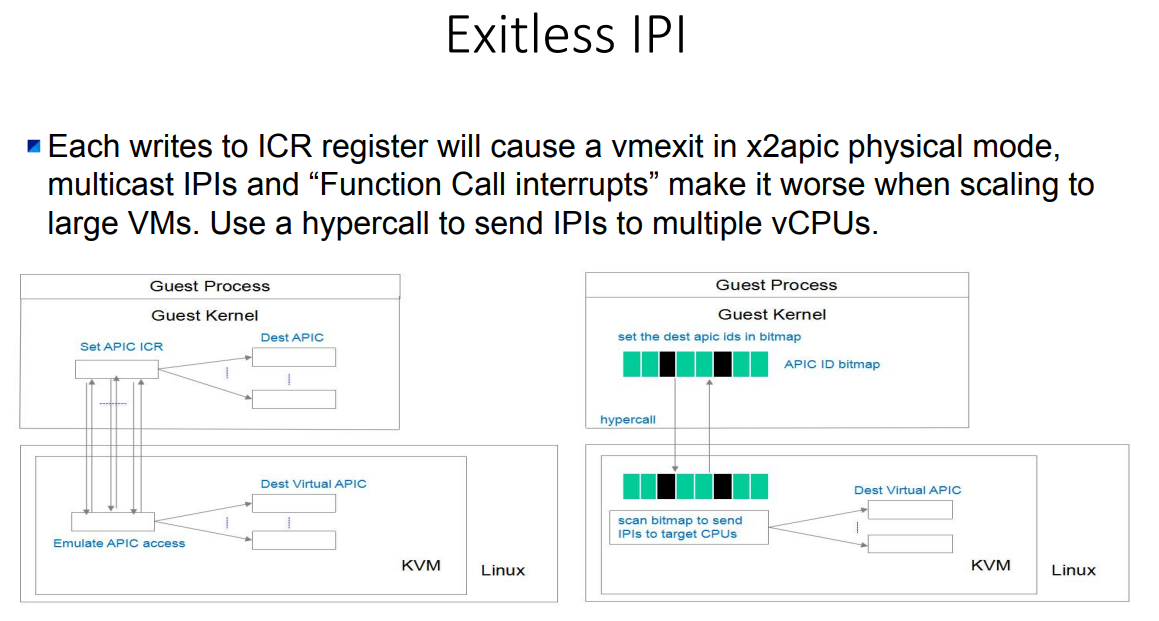
Instead of sending the IPI to vcpu one by one, the pv ipi send uses a bitmap to to record the IPI vcpu and then make a hypercall thus reduce the VM-exit. The patchset is here .
2. Usage Doc :
a0: lower part of the bitmap of destination APIC IDs
a1: higher part of the bitmap of destination APIC IDs
a2: the lowest APIC ID in bitmap
a3: APIC ICR

The hypercall lets a guest send multicast IPIs, with at most 128
128 destinations per hypercall in 64-bit mode and 64 vCPUs per
hypercall in 32-bit mode.  The destinations are represented by a
bitmap contained in the first two arguments (a0 and a1). Bit 0 of
a0 corresponds to the APIC ID in the third argument (a2), bit 1
corresponds to the APIC ID a2+1, and so on.

Returns the number of CPUs to which the IPIs were delivered successfully.
The test code in KVM unit test:
1
2
3
4
5
6
7
8
static void test_pv_ipi (void ) { int ret; unsigned long a0 = 0xFFFFFFFF , a1 = 0 , a2 = 0xFFFFFFFF , a3 = 0x0 ; asm volatile ("vmcall" : "=a" (ret) :"a" (KVM_HC_SEND_IPI), "b" (a0), "c" (a1), "d" (a2), "S" (a3)) ; report(!ret, "PV IPIs testing" ); }
a3就是kvm_pv_send_ipi函数中的icr参数。
1
2
3
4
5
6
7
8
9
10
11
12
13
14
int kvm_pv_send_ipi (struct kvm *kvm, unsigned long ipi_bitmap_low, unsigned long ipi_bitmap_high, u32 min, unsigned long icr, int op_64_bit) { ... if (icr & (APIC_DEST_MASK | APIC_SHORT_MASK)) return -KVM_EINVAL; irq.vector = icr & APIC_VECTOR_MASK; irq.delivery_mode = icr & APIC_MODE_MASK; irq.level = (icr & APIC_INT_ASSERT) != 0 ; irq.trig_mode = icr & APIC_INT_LEVELTRIG; ... }
3. Implementation 源码基于Kernel v5.17.0-rc1。
3.1 kvm side
1
2
3
4
5
6
7
8
9
10
11
12
13
14
15
16
17
18
19
20
21
22
23
24
25
26
27
28
29
30
int kvm_pv_send_ipi (struct kvm *kvm, unsigned long ipi_bitmap_low, unsigned long ipi_bitmap_high, u32 min, unsigned long icr, int op_64_bit) { struct kvm_apic_map *map ; struct kvm_lapic_irq irq =0 }; int cluster_size = op_64_bit ? 64 : 32 ; int count; if (icr & (APIC_DEST_MASK | APIC_SHORT_MASK)) return -KVM_EINVAL; irq.vector = icr & APIC_VECTOR_MASK; irq.delivery_mode = icr & APIC_MODE_MASK; irq.level = (icr & APIC_INT_ASSERT) != 0 ; irq.trig_mode = icr & APIC_INT_LEVELTRIG; rcu_read_lock(); map = rcu_dereference(kvm->arch.apic_map); count = -EOPNOTSUPP; if (likely(map )) { count = __pv_send_ipi(&ipi_bitmap_low, map , &irq, min); min += cluster_size; count += __pv_send_ipi(&ipi_bitmap_high, map , &irq, min); } rcu_read_unlock(); return count; }
1
2
3
4
5
6
7
8
9
10
11
12
13
14
15
16
17
18
19
static int __pv_send_ipi(unsigned long *ipi_bitmap, struct kvm_apic_map *map , struct kvm_lapic_irq *irq, u32 min) { int i, count = 0 ; struct kvm_vcpu *vcpu ; if (min > map ->max_apic_id) return 0 ; for_each_set_bit(i, ipi_bitmap, min((u32)BITS_PER_LONG, (map ->max_apic_id - min + 1 ))) { if (map ->phys_map[min + i]) { vcpu = map ->phys_map[min + i]->vcpu; count += kvm_apic_set_irq(vcpu, irq, NULL ); } } return count; }
3.2 guest side
1
2
3
4
5
6
static void kvm_setup_pv_ipi (void ) { apic->send_IPI_mask = kvm_send_ipi_mask; apic->send_IPI_mask_allbutself = kvm_send_ipi_mask_allbutself; pr_info("setup PV IPIs\n" ); }
1
2
3
4
5
6
7
8
9
10
11
12
13
14
15
16
17
18
19
20
21
22
23
24
25
26
27
28
29
30
31
32
33
34
35
36
37
38
39
40
41
42
43
44
45
46
47
48
49
50
51
52
53
54
55
static void __send_ipi_mask(const struct cpumask *mask, int vector ){ unsigned long flags; int cpu, apic_id, icr; int min = 0 , max = 0 ; #ifdef CONFIG_X86_64 __uint128_t ipi_bitmap = 0 ; #else u64 ipi_bitmap = 0 ; #endif long ret; if (cpumask_empty(mask)) return ; local_irq_save(flags); switch (vector ) { default : icr = APIC_DM_FIXED | vector ; break ; case NMI_VECTOR: icr = APIC_DM_NMI; break ; } for_each_cpu(cpu, mask) { apic_id = per_cpu(x86_cpu_to_apicid, cpu); if (!ipi_bitmap) { min = max = apic_id; } else if (apic_id < min && max - apic_id < KVM_IPI_CLUSTER_SIZE) { ipi_bitmap <<= min - apic_id; min = apic_id; } else if (apic_id < min + KVM_IPI_CLUSTER_SIZE) { max = apic_id < max ? max : apic_id; } else { ret = kvm_hypercall4(KVM_HC_SEND_IPI, (unsigned long )ipi_bitmap, (unsigned long )(ipi_bitmap >> BITS_PER_LONG), min, icr); WARN_ONCE(ret < 0 , "kvm-guest: failed to send PV IPI: %ld" , ret); min = max = apic_id; ipi_bitmap = 0 ; } __set_bit(apic_id - min, (unsigned long *)&ipi_bitmap); } if (ipi_bitmap) { ret = kvm_hypercall4(KVM_HC_SEND_IPI, (unsigned long )ipi_bitmap, (unsigned long )(ipi_bitmap >> BITS_PER_LONG), min, icr); WARN_ONCE(ret < 0 , "kvm-guest: failed to send PV IPI: %ld" , ret); } local_irq_restore(flags); }
It will set the bitmap accross the IPI target vcpu and finally call the kvm_hypercall4(KVM_HC_SEND_IPI).
参考资料:
KVM: X86: Implement Exit-less IPIs support kvm performance optimization technologies, part one Boosting Dedicated InstanceviaKVMTaxCut IOMMU(六)-post interrupt