本文将汇总Linux用户态程序获取时间的接口,本文内容主要转载自clock()、time()、clock_gettime()和gettimeofday()函数的用法和区别。
1. clock()
https://man7.org/linux/man-pages/man3/clock.3.html
1.1 概述
clock函数的返回值类型是clock_t,它除以CLOCKS_PER_SEC来得出时间,一般用两次clock函数来计算进程自身运行的时间.
clock有三个问题:
- 如果超过一个小时,将要导致溢出.
- 函数
clock没有考虑CPU被子进程使用的情况.
- 也不能区分用户空间和内核空间.
所以clock函数在linux系统上变得没有意义.
1.2 测试
编写程序,测试采用clock函数的输出与time程序的区别.
1
2
3
4
5
6
7
8
9
10
11
12
13
14
15
16
17
18
19
| #include <stdio.h>
#include <stdlib.h>
#include <time.h>
int main( void )
{
long i=1000L;
clock_t start, finish;
double duration;
printf( "Time to do %ld empty loops is ", i );
start = clock();
while (--i){
system("cd");
}
finish = clock();
duration = (double)(finish - start) / CLOCKS_PER_SEC;
printf( "%f seconds\n", duration );
return 0;
}
|
1
2
3
4
5
6
7
| $ gcc test1.c -o test1
$ time ./test1
Time to do 1000 empty loops is 0.180000 seconds
real 0m3.492s
user 0m0.512s
sys 0m2.972s
|
1.3 总结
- 程序调用
system("cd"),这里主要是子进程的消耗,test1程序不能体现这一点.
- 0.180000 seconds秒的消耗是两次
clock()函数调用除以CLOCKS_PER_SEC.
clock()函数返回值是一个相对时间,而不是绝对时间.CLOCKS_PER_SEC是系统定义的宏,由GNU标准库定义为1000000.
2. times()
https://man7.org/linux/man-pages/man2/times.2.html
2.1 概述
原型如下:
clock_t times(struct tms *buf);
tms结构体如下:
1
2
3
4
5
6
| struct tms{
clock_t tms_utime;
clock_t tms_stime;
clock_t tms_cutime;
clock_t tms_cstime;
}
|
tms_utime记录的是进程执行用户代码的时间.
tms_stime记录的是进程执行内核代码的时间.
tms_cutime记录的是子进程执行用户代码的时间.
tms_cstime记录的是子进程执行内核代码的时间.
2.2 测试
1
2
3
4
5
6
7
8
9
10
11
12
13
14
15
16
17
18
19
20
21
22
23
24
25
26
27
28
29
30
31
32
33
34
35
36
37
38
39
40
| #include <sys/times.h>
#include <stdio.h>
#include <stdlib.h>
#include <sys/types.h>
#include <unistd.h>
static void do_cmd(char *);
static void pr_times(clock_t, struct tms *, struct tms *);
int main(int argc, char *argv[]){
int i;
for(i=1; argv[i]!=NULL; i++){
do_cmd(argv[i]);
}
exit(1);
}
static void do_cmd(char *cmd){
struct tms tmsstart, tmsend;
clock_t start, end;
int status;
if((start=times(&tmsstart))== -1)
puts("times error");
if((status=system(cmd))<0)
puts("system error");
if((end=times(&tmsend))== -1)
puts("times error");
pr_times(end-start, &tmsstart, &tmsend);
exit(0);
}
static void pr_times(clock_t real, struct tms *tmsstart, struct tms *tmsend){
static long clktck=0;
if(0 == clktck)
if((clktck=sysconf(_SC_CLK_TCK))<0)
puts("sysconf err");
printf("real:%7.2f\n", real/(double)clktck);
printf("user-cpu:%7.2f\n", (tmsend->tms_utime - tmsstart->tms_utime)/(double)clktck);
printf("system-cpu:%7.2f\n", (tmsend->tms_stime - tmsstart->tms_stime)/(double)clktck);
printf("child-user-cpu:%7.2f\n", (tmsend->tms_cutime - tmsstart->tms_cutime)/(double)clktck);
printf("child-system-cpu:%7.2f\n", (tmsend->tms_cstime - tmsstart->tms_cstime)/(double)clktck);
}
|
1
2
3
4
5
6
7
8
9
10
11
12
13
14
| $ gcc test2.c -o test2
$ time ./test2 "dd if=/dev/zero f=/dev/null bs=1M count=10000"
10000+0 records in
10000+0 records out
10485760000 bytes (10 GB) copied, 4.93028 s, 2.1 GB/s
real: 4.94
user-cpu: 0.00
system-cpu: 0.00
child-user-cpu: 0.01
child-system-cpu: 4.82
real 0m4.943s
user 0m0.016s
sys 0m4.828s
|
2.3 总结
- 通过这个测试,系统的
time程序与test2程序输出基本一致了.
(double)clktck是通过clktck=sysconf(_SC_CLK_TCK)来取的,也就是要得到user-cpu所占用的时间,就要用 (tmsend->tms_utime - tmsstart->tms_utime)/(double)clktck)clock_t times(struct tms *buf)返回值是过去一段时间内时钟嘀嗒的次数.times()函数返回值也是一个相对时间.
3. gettimeofday()
https://man7.org/linux/man-pages/man2/gettimeofday.2.html
3.1 概述
gettimeofday()可以获得当前系统的时间,是一个绝对值
原型如下:
int gettimeofday (struct timeval * tv , struct timezone * tz)
timeval结型体的原型如下:
1
2
3
4
| struct timeval {
time_t tv_sec;
suseconds_t tv_usec;
};
|
所以它可以精确到微秒
3.2 测试
1
2
3
4
5
6
7
8
9
10
11
12
13
14
| #include <sys/time.h>
#include <stdio.h>
#include <unistd.h>
int
main(){
int i=10000000;
struct timeval tvs,tve;
gettimeofday(&tvs,NULL);
while (--i);
gettimeofday(&tve,NULL);
double span = tve.tv_sec-tvs.tv_sec + (tve.tv_usec-tvs.tv_usec)/1000000.0;
printf("time: %.12f\n",span);
return 0;
}
|
1
2
3
| $ gcc test5.c
$ ./a.out
time: 0.041239000000
|
4. clock_gettime()
https://www.man7.org/linux/man-pages/man3/clock_gettime.3.html
4.1 概述
原型如下:
int clock_gettime(clockid_t clk_id, struct timespec *tp);
有以下特点:
- 有一个时间结构体:
timespec,timespec计算时间的精度是ns.
1
2
3
4
| struct timespec{
time_t tv_sec;
long tv_nsec;
}
|
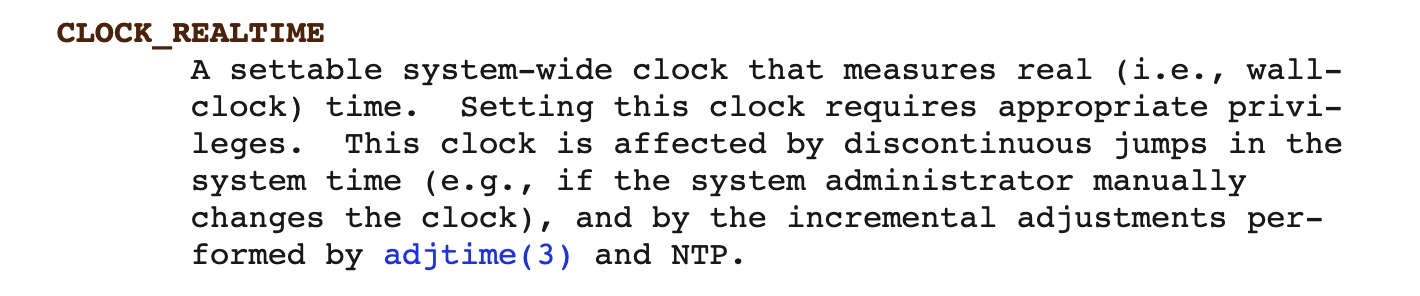
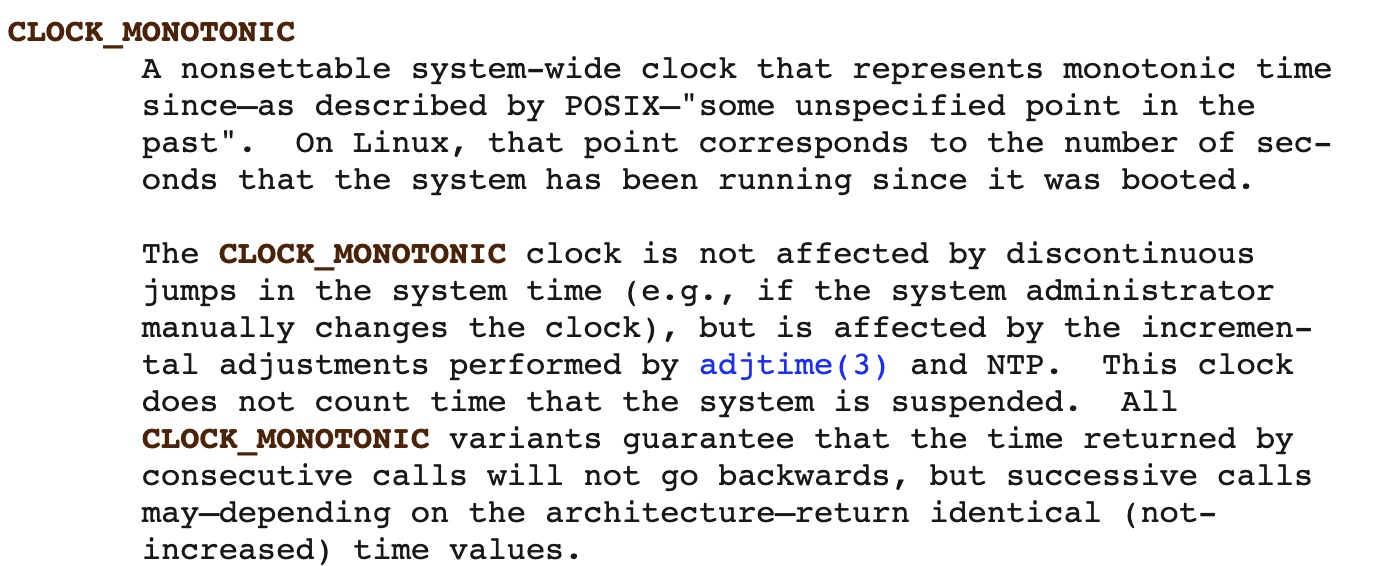
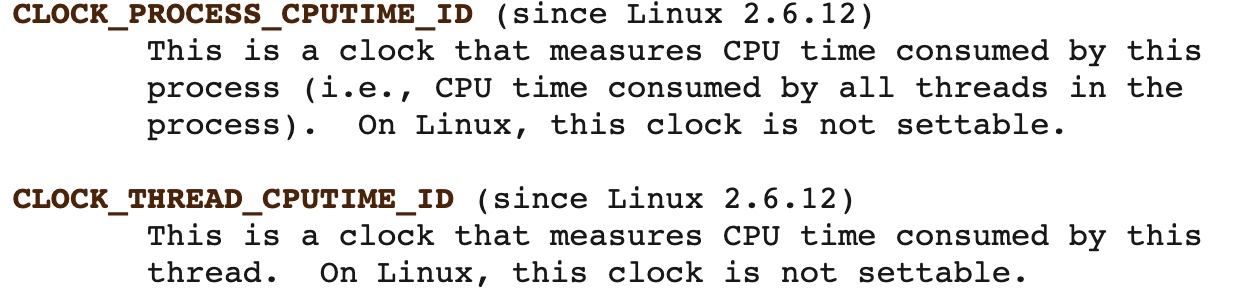
clockid_t确定哪个时钟类型.
CLOCK_REALTIME
CLOCK_MONOTONIC
CLOCK_PROCESS_CPUTIME_ID和CLOCK_THREAD_CPUTIME_ID.
4.2 测试:
1
2
3
4
5
6
7
8
9
10
11
12
13
14
15
16
17
18
19
20
21
22
23
24
25
26
| #include<time.h>
#include<stdio.h>
#include<stdlib.h>
#define MILLION 1000000
int main(void)
{
long int loop = 1000;
struct timespec tpstart;
struct timespec tpend;
long timedif;
clock_gettime(CLOCK_MONOTONIC, &tpstart);
while (--loop){
system("cd");
}
clock_gettime(CLOCK_MONOTONIC, &tpend);
timedif = MILLION*(tpend.tv_sec-tpstart.tv_sec)+(tpend.tv_nsec-tpstart.tv_nsec)/1000;
fprintf(stdout, "it took %ld microseconds\n", timedif);
return 0;
}
|
1
2
3
4
5
6
7
8
| $ gcc test3.c -lrt -o test3
$ time ./test3
it took 3463843 microseconds
real 0m3.467s
user 0m0.512s
sys 0m2.936s
|
5. 比较
5.1 精度
clock()的精度是10毫秒(ms)times()的精度是10毫秒(ms)gettimofday()的精度是微秒(μs)clock_gettime()的精度是纳秒(ns)
5.2 测试
1
2
3
4
5
6
7
8
9
10
11
12
13
14
15
16
17
18
19
20
21
22
23
24
25
26
27
28
29
30
31
32
33
34
35
36
37
38
39
40
41
42
43
44
45
46
47
48
| #include <stdio.h>
#include <stdlib.h>
#include <unistd.h>
#include <time.h>
#include <sys/times.h>
#include <sys/time.h>
#define WAIT for(i=0;i<298765432;i++);
#define MILLION 1000000
int
main ( int argc, char *argv[] )
{
int i;
long ttt;
clock_t s,e;
struct tms aaa;
s=clock();
WAIT;
e=clock();
printf("clock time : %.12f\n",(e-s)/(double)CLOCKS_PER_SEC);
long tps = sysconf(_SC_CLK_TCK);
s=times(&aaa);
WAIT;
e=times(&aaa);
printf("times time : %.12f\n",(e-s)/(double)tps);
struct timeval tvs,tve;
gettimeofday(&tvs,NULL);
WAIT;
gettimeofday(&tve,NULL);
double span = tve.tv_sec-tvs.tv_sec + (tve.tv_usec-tvs.tv_usec)/1000000.0;
printf("gettimeofday time: %.12f\n",span);
struct timespec tpstart;
struct timespec tpend;
clock_gettime(CLOCK_REALTIME, &tpstart);
WAIT;
clock_gettime(CLOCK_REALTIME, &tpend);
double timedif = (tpend.tv_sec-tpstart.tv_sec)+(tpend.tv_nsec-tpstart.tv_nsec)/1000000000.0;
printf("clock_gettime time: %.12f\n", timedif);
return EXIT_SUCCESS;
}
|
1
2
3
4
5
6
| $ gcc -lrt test4.c -o test4
$ ./test4
clock time : 1.190000000000
times time : 1.180000000000
gettimeofday time: 1.186477000000
clock_gettime time: 1.179271718000
|