Notes about INT(In-band Network Telemetry)
本文将mark下INT(In-band Network Telemetry)的相关notes。
telemetry: the science or process of collecting information about objects that are far away and sending the information somewhere electronically.
In-band Network Telemetry中文翻译:带内网络遥测
概念
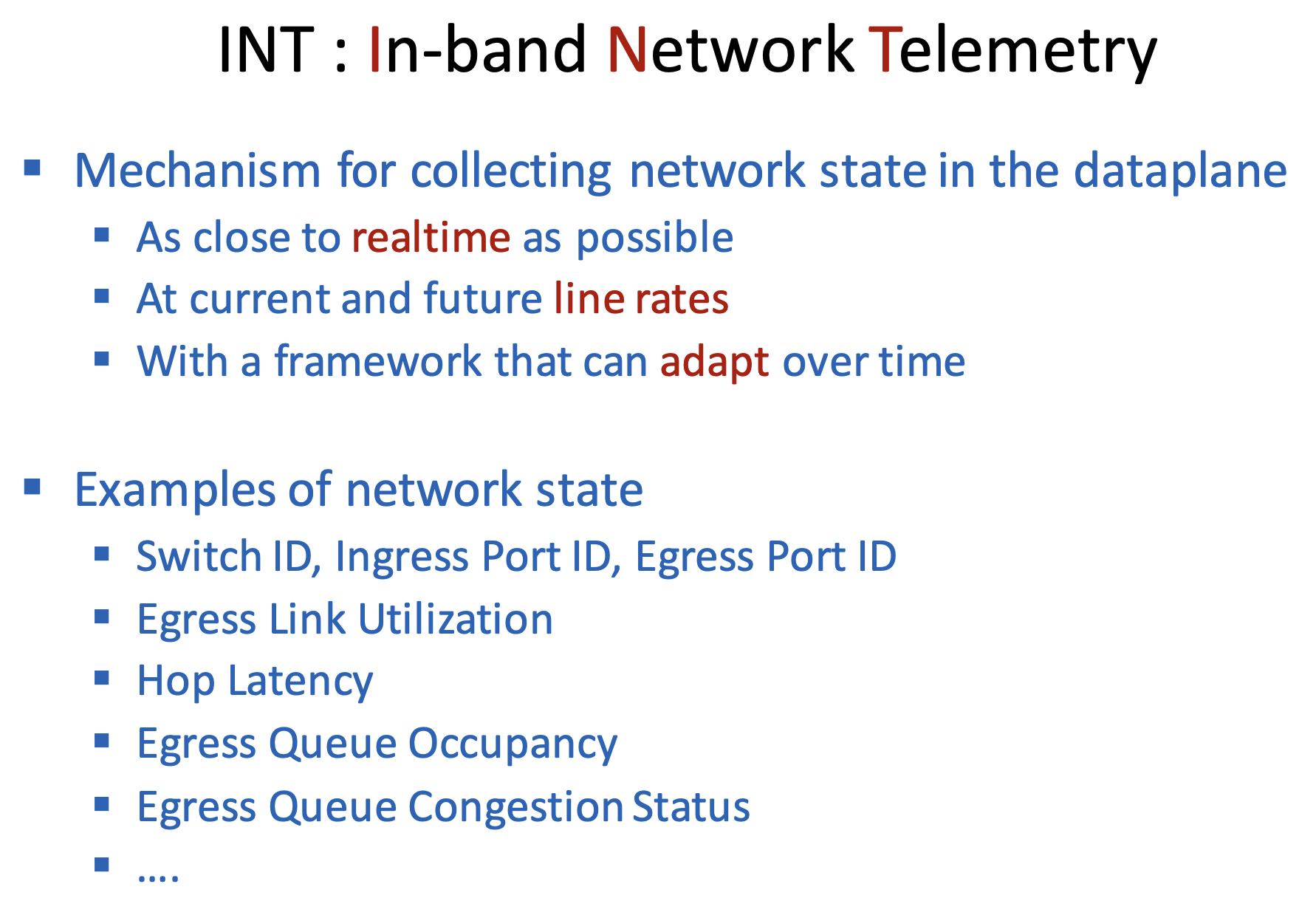
In-band Network Telemetry (INT) is a network monitoring framework for collecting and reporting network status, which collected by a data forwarding plane without the intervention of control plane. In an INT-defined framework, the messages can carry INT instructions which can be interpreted by the intermediate forwarding device and filled in with the expected data, and then continue to be forwarded until the destination. INT could be able to observe flow pattern changes caused by microbursts, packet transmission delays, delays per node, and new ports in the flow path.
Motivation
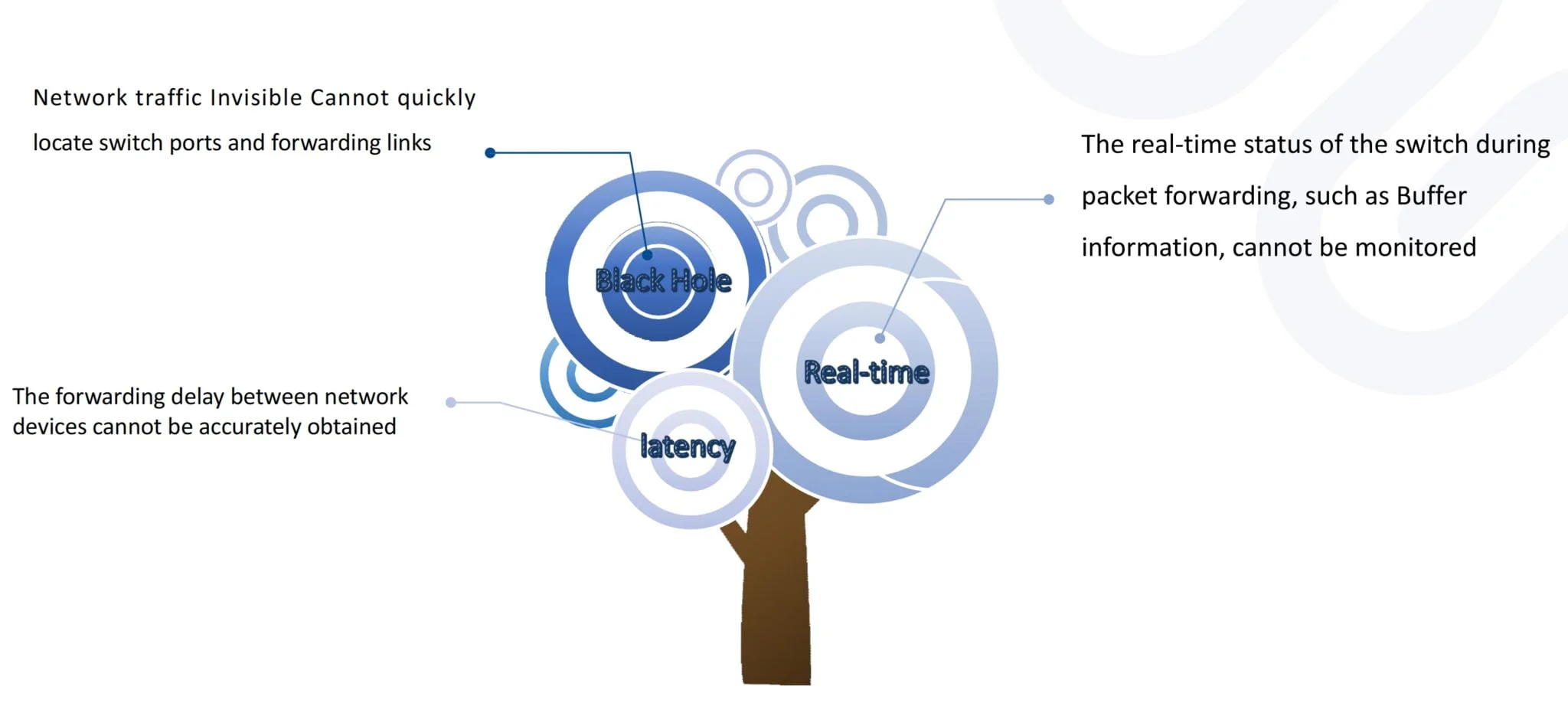
Challenges encountered in traditional network
原理
通常,一个 INT 域包含三类核心功能节点:INT 源节点(INT Source)、INT 宿节点(INT Sink)、INT 中转节点(INT Transit Hop)。
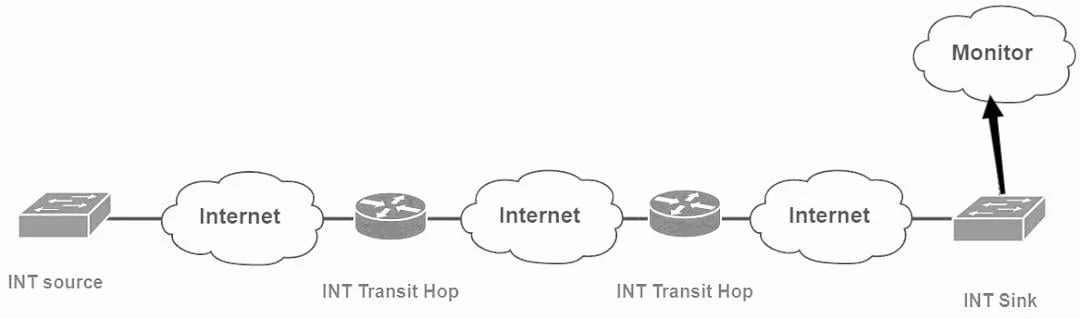
对于遥测运维人员,需要被遥测的流量会在源节点添加 INT 头部,头部中包含指示采集信息的指令集(INT Instruction),从而成为 INT 报文。当报文经过 INT 中转节点时,设备会按照指令集将采集到的信息(INT 元数据)插入 INT 报文,最终在 INT 宿节点弹出所有 INT 信息,并上报至监控设备。
对用户而言,流量的 INT 处理全程透明,用户无需感知该过程。
详细流程如下: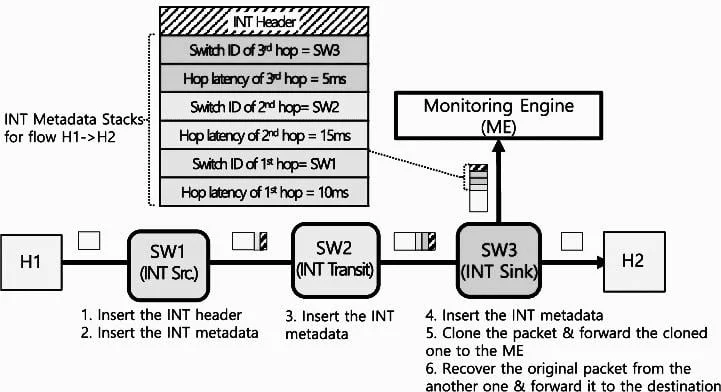
- Host H1 sends a data packet to H2
- SW1 inserts the INT header into the packet, the header source is SW1 and the sink is SW3
- SW1’s instruction is to collect SW ID and forwarding delay
- SW1 inserts its own ID and forwarding delay from ingress to exgress
- the middle switch SW2, SW3 repeat this process
- SW3 is the INT sink, which is responsible for summarizing the INT collection information and sending it to the report server.
HPCC
传统的拥塞控制,如果交换机上遇到了拥塞,就等到拥塞信号发到对端去,然后再返回回来,然后这个时候再去降速。但是这带来一个问题,就是降速可能并不是特别准确。所以HPCC里面的HP就是high precision,高精确度,也就是说交换机上面它能够有一个很高的精确度,然后去判断到底它拥塞的程度是什么样子,那就是用的可编程交换机的INT(In-band Network Telemetry)的能力,然后它把拥塞程度反馈的更准确,这样它调整带宽的时候就调的更准确。
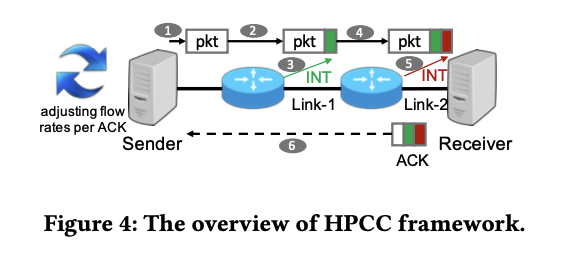
HPCC is a sender-driven CC framework. As shown in Figure 4, each packet a sender sends will be acknowledged by the receiver. During the propagation of the packet from the sender to the receiver, each switch along the path leverages the INT feature of its switching ASIC to insert some meta-data that reports the current load of the packet’s egress port, including timestamp (ts), queue length (qLen), transmitted bytes (txBytes), and the link bandwidth capacity (B).
When the receiver gets the packet, it copies all the meta-data recorded by the switches to the ACK message it sends back to the sender. The sender decides how to adjust its flow rate each time it receives an ACK with network load information.
参考资料: